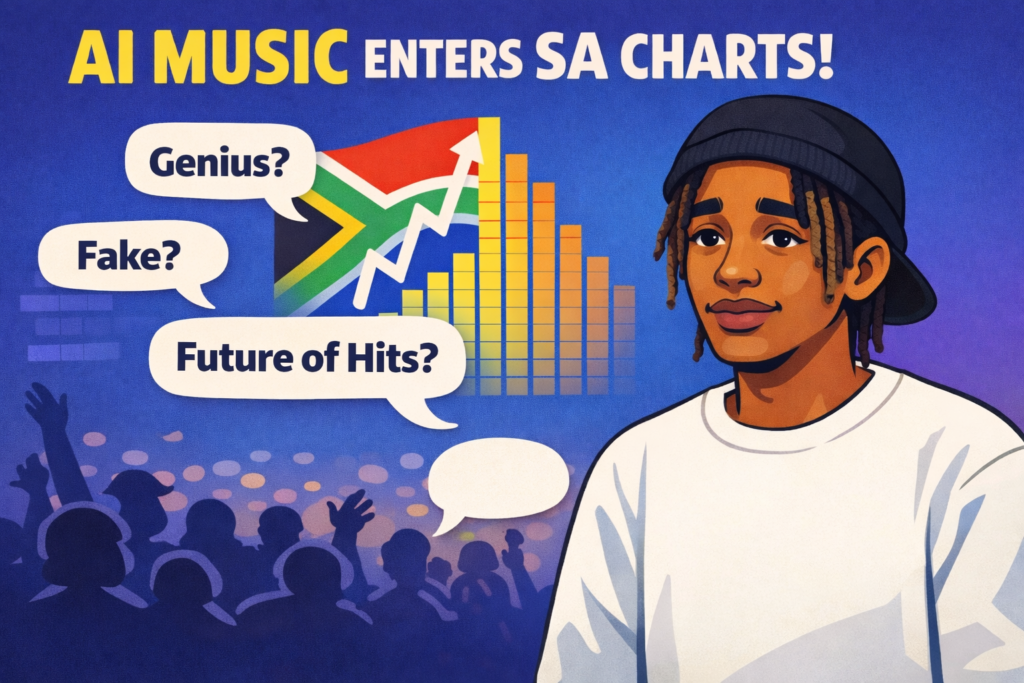
Right now in South Africa, AI music is not just a tech conversation — it’s a cultural argument. The kind that starts on Twitter, spills into podcasts, ends up in WhatsApp groups, and somehow lands in studios, gigs, and boardrooms.
The spark? An artist called Rea Gopane and his song Suka! (also referred to as Sugar in some conversations), which climbed the charts and got serious attention — while being widely labelled as AI-generated.
Once that happened, the conversation stopped being about whether the song is good or bad. It became about what it represents.
One Song, Many Opinions
As soon as Suka! started charting, timelines exploded.
Some people praised it as innovation.
Others felt disappointed.
Others were angry — not at the music, but at how it was made.
One viral tweet summed up the frustration clearly, questioning how an AI-generated amapiano song — allegedly trained on unlicensed voices, beats, and styles — could be celebrated as genius while real artists struggle for royalties and recognition.
Another popular reaction wasn’t even about music anymore. People joked that unfollowing someone just because they use AI-generated photoshoots is now “valid behaviour”. That tells you something: AI is starting to affect trust, not just sound.
At the same time, posts started popping up pointing out the numbers — AI-generated music charting on Spotify in South Africa. Not as a future prediction. As a current reality.
And that’s when things got serious.
Disappointment, Confusion, and the “Is Music Dead?” Feeling
Some listeners said they were genuinely disappointed when they found out the vocals weren’t human — especially because they already liked Rea Gopane’s music.
Others went even further, saying the songs sounded bad, yet were still pulling numbers. That alone made some people feel like:
“If this is winning, then what’s the point anymore?”
That feeling — that something unfair is happening — is what’s driving most of the noise. Not hatred. Not jealousy. Fear of being replaced by something that doesn’t even understand the culture.
Industry Voices Enter the Chat
Then the conversation moved from fans to industry heavyweights.
One of the most interesting reactions came from Euphonik, who compared AI music to food.
He basically said the same way you now have to check whether fruit is organic or whether salmon is farmed or wild — you’re going to have to start checking whether music is human-made or AI-made.
That analogy hit hard because it’s true. Authenticity is quietly becoming a premium.
DJ Maphorisa, Suno, and the Jokes That Aren’t Really Jokes
Then there was DJ Maphorisa, who didn’t approach the topic with panic — he approached it with curiosity, jokes, and subtle warnings.
He openly mentioned tools like Suno, joking that AI can do “anything,” while also pointing out its limitations. According to him and other producers, no matter how many prompts you try, AI still struggles with certain South African sounds, like proper 3-step.
One producer joked that maybe AI can’t do it yet because nobody has “fed it” that data.
That joke is actually very important.
Because it quietly confirms something most artists don’t want to hear:
👉 AI only knows what we give it.
My Take: I’m Not Scared
Let’s be clear.
I’m not scared.
I’m not worried.
And honestly, I’m not impressed either.
As my mother once said:
“Ngeke uhlulwe yinto engakhulumi.”
(You can’t be defeated by something that doesn’t even speak.)
AI should be worried about us, not the other way around.
Why? Because AI can’t create something new. It can only remix what already exists. That’s why even the vocals on these AI songs sound familiar. You’ve heard that tone before. You’ve heard that phrasing before. Nothing feels foreign.
And as long as real artists stop feeding AI their originality, this thing doesn’t move as fast as people think.
Stop Teaching AI How to Be You
This is the part artists really need to hear.
If you make original music:
- Don’t upload your songs into AI tools “just to test”
- Don’t ignore distribution terms and conditions
- Don’t give away your sound for convenience
Because once you do that, you’re basically helping create 10,000 versions of yourself — without getting paid.
That’s not AI being dangerous.
That’s artists being careless.
Go Physical, Go Human
Another uncomfortable truth: streaming doesn’t pay enough for most artists. And AI lives comfortably inside streaming platforms.
If you really want growth and money:
- Perform live
- Sell physical products
- Build direct relationships
- Create moments people can’t download
Yes, distribution platforms are convenient. Yes, people love convenience. Even building your own website is tricky. So artists will still upload music — that’s reality.
But the real power is offline.
Sol Phenduka’s Take: The Most Balanced View So Far
One of the most important voices in this conversation has been Sol Phenduka on Podcast and Chill.
Sol didn’t come in angry. He came in honest.
He said AI is here, and it’s not going anywhere. And that purists — people who dedicated their whole lives to music — now sound like meter taxi drivers when Uber arrived. Guys who spent everything buying taxis, only to be disrupted by an app.
That comparison matters. Because disruption always feels unfair.
But Sol didn’t stop there.
“Prompting Is Not Creating”
Sol made a very clear point:
He doesn’t respect producers who use AI completely.
Typing prompts like:
“Jazz chords, electric piano, soulful vibe”
…doesn’t make you a creator.
With a description like that, AI can generate millions of songs. You’re not in control. You didn’t hear anything in your head. You’re just hoping the machine surprises you.
According to Sol, real creators hear melodies internally. They understand BPM, key, chords, structure. And only then can AI be useful — as a tool that follows instructions, not as a replacement.
Where AI Actually Helps
Sol also explained where AI actually makes sense, especially in South Africa.
Not every producer has access to session musicians. In amapiano, you often hear programmed sax lines — sometimes they don’t sound great, but the idea behind them is solid.
With AI, you can take your composed melody and tell it:
“Play this exactly, but make it sound live.”
That’s no different from calling a musician and telling them what to play.
The control stays with you.
“Everyone’s Granny Will Have an Album”
Sol joked that soon, everyone — even your granny — will have an AI album, and some of them might even sound better on the surface.
But sounding polished doesn’t mean it has soul.
And culture can’t be automated.
So Why Is AI Getting So Much Attention in SA?
Because it touches money, culture, ego, access, and fear — all at once.
It’s not just about music.
It’s about who gets paid.
Who gets recognised.
And who gets replaced.
Final Thoughts
AI is loud right now.
But it’s not the end.
If you’re a South African artist:
- Protect your originality
- Read what you’re signing
- Use AI if it helps — don’t let it replace you
- Stay connected to real people
AI can remix what already exists.
Artists create what comes next.
We’ll be attaching tweets, podcast clips, and updates as this conversation continues — because this story is far from finished.

